"All photographs are accurate, none of them are truth"
- Richard Avedon 1984
Spirit photography: Beginning around the time of the Civil War,
photographers such as William Mumler andE. Buguet created images revealing supposed paranormal activity.As a sitter has their portrait taken, long
dead relatives can be seen floating behind them, objects levitate, and
mysterious forms appear without physical explanation.Spiritualismproposed that the spirits of the dead could co-exist and communicate
with the living. The photographers who participated played on the emotions of
those mourning the dead.These images
document a time when the objective truth of a photograph was not questioned.
After
the writer and curator Maurice Berger died, in the early days of the
pandemic, his husband, Marvin Heiferman started sharing his grief through images.
... Heiferman posted a picture to Instagram of an American
flag twisted tortuously around a pole affixed to a wet, leafless tree.
“I looked at it, and I thought, That’s fucked up, and that’s how I
feel,” Heiferman said recently. “I realized that there were no words
that expressed what I was feeling. But I saw this thing that did.”
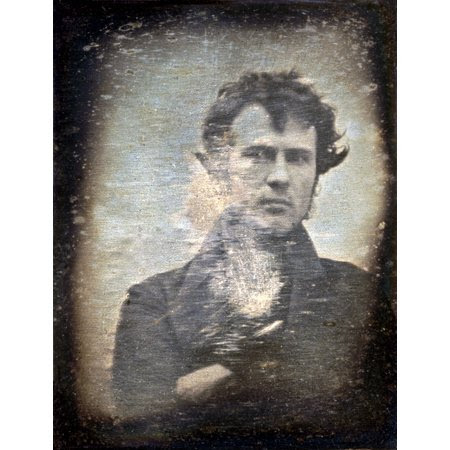
Ever since the year the Daguerreotype was released to the public in 1839, photographers have been turning the camera upon themselves...
Robert
Cornelius, Self-Portrait,
Daguerreotype, November or December 1839
Often these have became famous photographer's best-known works...
Ilse
Bing, Self-Portrait in Mirror, 1931
Or even unknown photographers, later discovered after their deaths, most beloved works...
Vivian Maier: Self-Portraits Hardcover – Illustrated, October 29, 2013
Vivian Maier self-potrait circa 1950s
Artist Cindy Sherman is most well known for her Untitled
Film Stills, an analog photography series from the 1980s in which Sherman
herself uses elaborate make-up and costume to act out iconic female personas
from film, television, and consumer culture of the mid–late
20th century.
Cindy Sherman (B. 1954) Untitled Film Still #21
Sherman began using Instagram in recent years as a means of
circulating her elaborate, digitally manipulated self-portraits.
Cindy Sherman, Previously Unpublished
Artist Amalia Ulman, in response to the idea
that social media is a way to sell one’s personal “brand”, staged a five month
scripted performance inspired by “total makeover” culture.Her Instagram feed, evoking a consumerist
fantasy lifestyle, was excessive yet believably familiar.Ulman went to great lengths to replicate the
narrative conventions of similar lifestyle feeds. The idea was conceived of as
a “boycott” of her own online persona.The project was meant to highlight a disconnect between our online
personas and ourselves, to critique the ’exposure at any cost-culture’
encouraged by social media, while also implicating herself within that
culture.Ulman admitted that while much
of the new identity she created for “Excellences and Perfections” was
fabricated, there was an element of truth to her personality revealed as a
result.
NYT Art for tomorrow 2017: The Instant Image for the Global Audience
This post relates to Jurgenson p.53-82, which should be quoted in your blog post due May 9.
Agnes Martin's paintings which utilize line, grid, and transparent
layers of color that can be deceiving at first glance. Martin rejected
the idea that art should be intellectual, and believed instead that art
should come from spiritual inspiration. Her work is historically placed
within the minimalist tradition (among other artists who created art
using basic forms stripped down to their essentials) but on close
inspection her paintings become celebrations of the trace of the artist's hand. The
video below gives us a revealing glimpse at her meditative process of
painting.
Agnes Martin, "Beauty is in Your Mind", Tateshots, 2015
Agnes Martin, Untitled (Image #4) 1998
Agnes Martin, Untitled, 1960
Agnes Martin, Happy Holiday, 1999
Trailer of the new documentary by Leon d'Avigdor about the painter Agnes Martin.
The Art Channel explores the Agnes Martin exhibition at Tate Modern
This is Roy Decarava's most known image, viewed by millions in Moma's Family of Man exhibition.
Roy DeCarava, Graduation, 1949
Without the two main subjects, the girl in the formal dress
and the Chevrolet billboard, this would be a very conventionally framed
photograph of an empty lot. This balance creates a solid stage for these two unrelated
elements to interact. Our eye is first drawn to the figure in the striking
dress, contrasting with its murky, unglamorous surroundings. The girl’s posture
leads us to the advertisement, which because of the way it’s cropped into, weirdly
maintains its original graphic hierarchy, which emphasizes the text. Had the
entire frame of the billboard been included it would become more objectified and less
communicative. This relationship between figure and ad copy is further
strengthened by scale, the billboard being at a distance which makes the car in close
proportion to the girl. A generation before, during the great depression, it
was a photographic cliché to show looming advertisements above soup kitchen
lines. Here a relationship is established that is more complex and open to
interpretation.
Roy DeCarava, Sun and Shade
"A
photograph is a photograph, a picture, an image, an illusion complete
within itself, depending neither on words, reproductive processes or
anything else for its life, its reason for being."
Roy DeCarava
Roy DeCarava, from the series The Sound I Saw
Roy DeCarava: Seeing People. Seeing Jazz.
A short documentary by Moshe Quinn
In the second half the Social Photo section Documentary Vision Jurgenson discusses the I was there, I did that sensibility as it is depicted on social media. Everything comes across with a bit of a 'sugar high'...always a bit elevated from everyday reality via the streamlining powers of abstraction. We also often see some form of nostalgia involving recent, or distant times, commonly defined as 'the jealousy the present has for the past'. Somehow we see these two ideas mutate in the official videos and album trailers of Lana Del Ray, where she seems to live in a past that never existed.
Lana's career was kick started by the viral activity stirred up by the found footage video for her song Video Games. As these videos age they seem to become a kind of dated nostalgia, one that may reflect a 2012 idea of what the 1950s mixed with 1990s should look like. That doesn't deter younger artists like Maggie Lindemann from going down a similar path...
...but maybe with more restraint and a different twist on 'camp'. Then there's an alternative sensibility that's a bit more real, complete with some comic documentary reenactment;
Thao & The Get Down Stay Down deconstruct the 'serious pop star' sensibility and offer something more organic, with a good amount of live performance and behind the scenes video on their site.
Older artists can indulge in more of an archive sensibility. Niel Young's youtube channel is an extension of his online music store, which actually called Niel Young Archive;
Dion Francis DiMucci, better known as Dion, has a sensibility more interested in now than then, but he isn't afraid to confront the past! Here he tries to remember everything possible about the tour that ultimately took the lives of Buddy Holly, Ritchie Valens, and the Big Bopper. These were clearly the bad old days, played out in the winter hell of Wisconsin.
Between 1925 and 1954 Frida Kahlo painted 55 self-portraits. In most of
these she confronts the viewer in a full-frontal, straight-on manner.
This helps her bring you into her world. She wants you to feel her pain,
and her passion.
'The Broken column' painted in 1944
Much
of her pain was physical. Her health problems began when she contracted
Polio at age 6. At age 18 a bus she was riding in was struck by a
streetcar and she was impaled by a handrail and her pelvis, spine and
leg received multiple fractures. It was during this bedridden recovery
period when she began painting seriously. But she never did really
recover. In her lifetime she would have 35 surgeries and would wear 50
different supportive corsets and a prosthetic leg.
'Self-Portrait with Monkeys' painted in 1943
Her
damaged body did nothing to suppress the power that emanates from the
inner self here. We are left to wonder what her understanding of 'self'
really was and how she was able to so directly communicate something so
intangible.
Composition was one of her tools. Her figure is slightly off center in these, eyes toward the viewer, with head slightly turned away.
This type of composition is simple to emulate with electronic media, especially with a camera on a tripod, responding to a central pose, or a centered element, with a slight de-centering. This may evoke disruption, or it may make the image more dynamic.




.jpg)


