Wednesday, January 29, 2014

Something is Happening...


Bob Dylan performing Ballad of a Thin Man, referenced on page 104-106 of Marshall McLuhan's The Medium is the Massage, in another YouTube clip of unknown origin. There is a definite visual similarity to D.A. Pennebaker's Don't Look Back. A truly amazing, spirited performance. McLuhan must have been impressed with the song as well, dedicating three pages of the book to Dylan's likeness and the words:

"Because something is happening
 But you don't know what it is
 Do you, Mister Jones?"

Although many have tried to link the lyrics to specific people and events, the song can be interpreted as a universal critique of people unaware of the world around them. It was one of a very few songs Dylan kept performing over the years, typically introducing it with the reflection that "there are still a lot of Joneses out there."

Monday, January 27, 2014

Robert Frank's Journey to the Outside


Robert Frank tells us it wasn't so much about art as it was about life in this 2008 interview, conducted on the occasion of the 50th anniversary of the first printing of    The Americans.


Sarah Greenough discusses the structure of The Americans in this video. She authored the 528 page volume that investigates Frank's Guggenheim project and the resulting 180 page book, first published in the United States in 1959.

Thursday, January 23, 2014

Sandy Dyas: my eyes are not shut

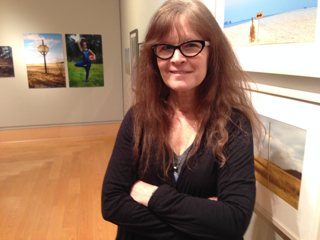
Sandy Dyas installing her exhibition, my eyes are not shut,
in the Wriston Art Center Galleries,
Lawrence University, Appleton, Wisconsin
January 15, 2013. iPhone photo by. J. Lindemann

"Be brave. Brave enough to listen to yourself," artist Sandy Dyas told a group of Digital Processes students at Lawrence University while on campus to install and open her "my eye are not shut" exhibition. The show at the Wriston Art Center Galleries runs January 17-March 16, 2014 and flows with around 100 prints installed with video. Color, form, light, and subject matter inter-relate associatively from one print to the next to communicate something of "the ever-changing, strange and beautiful world we live in." 
 
Dyas felt completely at home when she discovered the Intermedia MFA program at the University of Iowa in Iowa City in the 1990s. "My curiosity of the unknown drew me to Intermedia," she said. At the time the focus was on experimental video, performance, and the ephemeral. She describes her time there from 1992-1998 as utopian. There was a built-in community and she had access to video equipment. Dyas, Ana Mendieta, and Charles Ray are among the program's alum. "An outgrowth of Fluxus ideas of interdisciplinary creative activities, artist Hans Breder founded this first Intermedia MFA program in the US in 1968. It explored the "liminal spaces between the arts: art, music, film, dance, theater, and poetry" eventually embracing the liberal arts and currently social practice and all things digital.

"Experimentation was encouraged over everything," Dyas says. "We would endlessly discuss the merits and concepts of a work - although Hans was short on giving his opinions - I mean, he did, but he did not interfere with anyone’s creativity. I saw him as a figure who watched and listened intently but said very little — or at least did not elaborate. I believe what he did was create a safe and very open space for students to experiment with ideas." 
 
In the spirit of this experimentalism, Dyas used current online platforms to self-produce the exhibition and the accompanying book using Kickstarter and Blurb. She currently teaches photography and an Intermedia course at Cornell College embracing simple performance, performance on video, and the study of artists active in the 1960s and 1970s.

Sandy Dyas visits Digital Processes students on January 15, 2014. Photo by Sony

Saturday, January 18, 2014

Bell Labs Built the first Picturephone in 1956...

This ad likely corresponded with its appearance at the 1964 World's Fair. Of special note is the caption next to the screen image.

Saturday, January 11, 2014

Stan Brakhage: Expanding the Language of Film, Frame by Frame

One may read infinite interviews with independent filmmakers whining about making a $3,000,000 film on a $750,000 budget, but can we really pity them after we consider how Stan Brakhage (1933-2003) expanded the creative potential of the entire medium using nothing but blank film stock and some felt tip markers? The immensely influential filmmaker completed over 300 films while living a low budget life, working with amateur equipment and discards. His films take us to the extremes of our emotional states while dismissing the tedium of narrative structure. He has opened the doors to new understandings of human experience to all willing to accept his art.

Stan Brakhage - "Eye Myth" (1967)

Sunday, January 5, 2014

One of the Greatest Men of All Time


Douglas Engelbart (1925-2013), whose vision of collaboration using computer technology to help solve the urgent and complex problems of all of humanity, died on July 2, 2013. His comrades believed that his ideas were never fully realized due to his ideas and generosity of spirit. For example, he resisted patenting the "mouse" he'd invented and it eventually fell into the public domain. The robotic rigidity of institutions is also to blame -- most powerful technology companies in American relegated him to R&D. Ted Nelson, professor and inventor of the first hypertext project, delivered Engelbart's eulogy on December 9, 2013. In his tearful delivery, he said the "...real ashes to be mourned are the ashes of Doug’s great dreams and vision, that we dance around in the costume party of fonts that swept aside his ideas of structure and collaboration...Perhaps his notion of accelerating collaboration and cooperation was a pipe dream in this dirty world of organizational politics, jockeying and backstabbing and euphemizing evil." Engelbart articulated his ideas for collaboration publicly in what is known as The Mother of all Demos delivered on December 9, 1968, nearly half a century ago. Some of what he described is still in the process of being realized in commercial forms such as Skype, Google Docs, and more.