Monday, February 10, 2014

John Cage Big Daddy

Margaret Leng Tan performance exerpt of In the Name of the Holocaust from John Cage, I Have Nothing To Say, And I Am Saying It, PBS American Masters, 1990


Margaret Leng Tan

"Cage liberated 20th-century American music from the almighty European tradition and gave American composers the confidence to be themselves. In fact, not only composers but American artists in general. One can go so far as to say Cage gave all artists the confidence to be themselves. In essence, we are all Cage's spiritual children."

from 33 Musicians On What John Cage Communicates by Max Blau
npr.org


Tuesday, February 4, 2014

Something Happened


Bob Dylan's appearance in a 2-minute advertisement promoting Chrysler cars, Detroit, and American pride aired during the SuperBowl on February 2, 2014.

HERE WE HAVE the principle of commodity fetishism, the domination of society by things whose qualities are "at the same time perceptible and imperceptible by the senses." This principle is absolutely fulfilled in the spectacle, where the perceptible world is replaced by a set of images that are superior to that world yet at the same time impose themselves as eminently perceptible.

           -Guy Debord, Thesis 36, The Society of the Spectacle                                                         translation by Donald Nicholson-Smith

Wednesday, January 29, 2014

Something is Happening...


Bob Dylan performing Ballad of a Thin Man, referenced on page 104-106 of Marshall McLuhan's The Medium is the Massage, in another YouTube clip of unknown origin. There is a definite visual similarity to D.A. Pennebaker's Don't Look Back. A truly amazing, spirited performance. McLuhan must have been impressed with the song as well, dedicating three pages of the book to Dylan's likeness and the words:

"Because something is happening
 But you don't know what it is
 Do you, Mister Jones?"

Although many have tried to link the lyrics to specific people and events, the song can be interpreted as a universal critique of people unaware of the world around them. It was one of a very few songs Dylan kept performing over the years, typically introducing it with the reflection that "there are still a lot of Joneses out there."

Monday, January 27, 2014

Robert Frank's Journey to the Outside


Robert Frank tells us it wasn't so much about art as it was about life in this 2008 interview, conducted on the occasion of the 50th anniversary of the first printing of    The Americans.


Sarah Greenough discusses the structure of The Americans in this video. She authored the 528 page volume that investigates Frank's Guggenheim project and the resulting 180 page book, first published in the United States in 1959.

Thursday, January 23, 2014

Sandy Dyas: my eyes are not shut

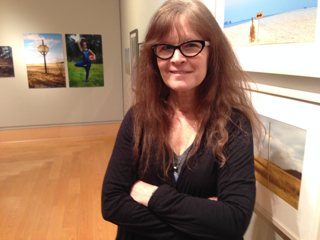
Sandy Dyas installing her exhibition, my eyes are not shut,
in the Wriston Art Center Galleries,
Lawrence University, Appleton, Wisconsin
January 15, 2013. iPhone photo by. J. Lindemann

"Be brave. Brave enough to listen to yourself," artist Sandy Dyas told a group of Digital Processes students at Lawrence University while on campus to install and open her "my eye are not shut" exhibition. The show at the Wriston Art Center Galleries runs January 17-March 16, 2014 and flows with around 100 prints installed with video. Color, form, light, and subject matter inter-relate associatively from one print to the next to communicate something of "the ever-changing, strange and beautiful world we live in." 
 
Dyas felt completely at home when she discovered the Intermedia MFA program at the University of Iowa in Iowa City in the 1990s. "My curiosity of the unknown drew me to Intermedia," she said. At the time the focus was on experimental video, performance, and the ephemeral. She describes her time there from 1992-1998 as utopian. There was a built-in community and she had access to video equipment. Dyas, Ana Mendieta, and Charles Ray are among the program's alum. "An outgrowth of Fluxus ideas of interdisciplinary creative activities, artist Hans Breder founded this first Intermedia MFA program in the US in 1968. It explored the "liminal spaces between the arts: art, music, film, dance, theater, and poetry" eventually embracing the liberal arts and currently social practice and all things digital.

"Experimentation was encouraged over everything," Dyas says. "We would endlessly discuss the merits and concepts of a work - although Hans was short on giving his opinions - I mean, he did, but he did not interfere with anyone’s creativity. I saw him as a figure who watched and listened intently but said very little — or at least did not elaborate. I believe what he did was create a safe and very open space for students to experiment with ideas." 
 
In the spirit of this experimentalism, Dyas used current online platforms to self-produce the exhibition and the accompanying book using Kickstarter and Blurb. She currently teaches photography and an Intermedia course at Cornell College embracing simple performance, performance on video, and the study of artists active in the 1960s and 1970s.

Sandy Dyas visits Digital Processes students on January 15, 2014. Photo by Sony

Saturday, January 18, 2014

Bell Labs Built the first Picturephone in 1956...

This ad likely corresponded with its appearance at the 1964 World's Fair. Of special note is the caption next to the screen image.