Milwaukee Art Museum curator Lisa Hostetler showed us Evan Baden'sIlluminati series on a visit to the MAM Print Room. He'd made the work while an undergraduate at the College for Visual Studies in St. Paul (to close in June 30, 2013). We emailed Evan to arrange a visit to his studio in Minneapolis/St. Paul in June of 2011 where he showed us his provocative Technically Intimate series that we'd seen excerpts of in various glossy magazines. The walls of his small studio were covered with blow ups of his best images and he pulled out a few work prints of experiments. The Lawrence University Photography Club, lead by the dynamic Will Melnick, invited Evan to speak on his work and visit with students March 5-6, 2013. In his lecture, Evan pointed to the painstaking detail to convey his understanding of his extensive Internet research of online phenomena. His photographs ultimately critique how online experience is shaping real world relationships. He covered his resourceful technical practices too. Most memorable was adding supplemental light with three iPods to most convincingly simulate the illumination provided by the handheld electronic devices shown in Illuminati. His latest series, Under the Influence, examines how teens perform themselves and their sexuality for the camera (see below image). His 4x5 format view camera and use of color negative film heightens the intensity of such coreographed performances embellished by props and supervised by parents. The prints are titled with captions taken directly from mainstream magazines. Museums and galleries in the US and Europe have included his work in exhibitions interrogating technology and its impact. Baden ships rolled-up prints or uploads files to servers for output on location. The venue mounts the print on aluminum, exhibits then destroys it. Some prints make their way into museum collections rather than face destruction or the expense of crating and return shipping. Evan is working on an MFA at Columbia College in Chicago and lives in Oak Park while he juggles the demands of an international speaking/exhibition schedule, making work, and teaching.
Karlheinz Stockhausen (1928-2007), the most important and
controversial electronic composer of the 20th and 21st centuries
"Where a visual space is an organized continuum of a uniformed connected kind, the ear world is a world of simultaneous relationships," writes Marshall McLuhan in The Medium is the Massage (1967). The "ear world" influence of German electronic composer, Karlheinz Stockhausen, trickled down to the pop level via The Beatles and others bands of the 1960s creating many "simultaneous relationships". His electronic, spatial, and chance compositions (e.g. "variable form") influenced other 1960s pop musicians as well, including Frank Zappaand Pete Townsend. The Beatles included his face on the cover montage image of their album, Sgt. Pepper's Lonely Hearts Club Band(1967). Inspired by Stockhausen and the Fluxus sound experiments of Yoko Ono (now 80 years old and a huge Twitter and Instagram user), Beatle John Lennon wanted to make his own experimental sound piece. Lasting more than 8 minutes, Revolution 9, contained random everyday sounds and tape loops (some from the archives of EMI ) of cheering crowds, cooing babies, random conversation, orchestral music, and laughter. The Stockhausen-influence as heard in Hymnen(1967), made up of electronically manipulated national anthems, is obvious. After some controversy, Revolution 9 (1968) was included on THE BEATLES (a/k/a "The White Album"). The most accessible Stockhausen sound continuum may very well be the Beatles' A Day in the Life. The culminating track on their Sgt. Pepper's album, it includes sounds of an alarm clock, panting, and piano strings aggressively banged and left to decay. "The ringing of the piano went on and on and on...with an 18 kHz track for dogs to listen to," said producer George Martin in a video interview (below). Marshall McLuhan writes of the Beatles influence on "musical effects":
Myth means putting on the audience, putting on one's environment. The Beatles do this. They are a group of people who suddenly were able to put on their audience and the English language with musical effects--putting on a vesture, a whole time, a Zeit. (p. 114)
George Martin talks about "A Day in the Life" by the Beatles
The generally affable Bill Owens (American 1938- ) had just returned from a stint in the Peace Corps. He observed the normalcy yet strangeness of the burgeoning American suburbs. While working for the Livermore Independent as a photojournalist, he became intrigued by suburban Livermore. He photographed on assignment and made pictures of people in their homes doing what they do for work and leisure. After he had enough material and was laid off, he collected quotes as text to make something substantial, a book titled Suburbiapublished in 1973. Though his photographs were collected and exhibited by prestigious museums from the MOMA to the Getty, it wasn't a living. He had a family to support. Always entrepreneurial and a believer in self-publishing, he wrote a book about making books (extremely rare) after his own experiences. He later quit pursuing the "art world" to put his energy into more economically viable projects like a brew pub (1983) and later distilling (2004). As Canadian media critic Marshall McLuhan wrote in his 1967 book, The Medium is the Massage: "The poet, the artist, the sleuth--whoever sharpens our perception tends to be antisocial; rarely "well adjusted," he cannot go along with currents and trends. A strange bond often exists among anti-social types in their power to see environments as they really are." (p. 88). Owens did exactly that in his books and ongoing projects. Entering suburban space in earnest to photograph, he left us with a critique of a lifestyle that today may strike us as comic yet coaxes feelings of pity. McLuhan continued, "Humor as a system of communications and as a probe of our environment--of what's really going on--affords us our most appealing anti-environmental tool. It does not deal with theory, but in immediate experience, and is often the best guide to changing perceptions." (p. 92). Perusing the Suburbia work today becomes an act of discovery, a probe of a mental space and a place that once was. Decades later, suburbia has mutated throughout America into a boundless sprawl of fast food restaurants, faux artisinal boutique stores, big box stores, parking lots, seemingly infinite beige, gray, and white cookie cutter houses, and vacant McMansions.
Cartoonist and author Lynda Barry presented an evocative convocation at Lawrence University on Thursday, January 24, 2013 wearing smart velvet hat and long braids. She has been a keen observer of digital culture noting that parents spend more time looking at their smart phones than looking at their children's faces. Holding her arms up in the air and wiggling her fingers, she pointed out that fingers are the original digital media. Telling a naughty joke about snoring and balls that her farmer neighbors told her, she amused the audience but made the college president squirm. Barry let her freak flag fly and the audience loved it on a cold January day.
Chris Burden, Shoot,November 19, 1971,
F Space, Santa Ana, CA
"We have now become aware of the possibility of arranging the
entire human environment as a work of art, as a teacing machine
designed to maximize perceptoin and to make
everyday learning a process of discovery."
Marshall McLuhan, The Medium is the Massage, 1967
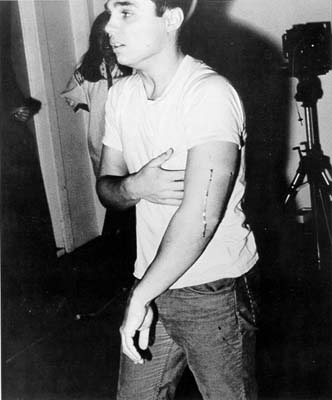
Pondering Chris Burden's performance piece, Shoot,mounted at F-Space in Santa Ana on November 19, 1971, we see that Burden (who studied for his B.A. in visual arts, physics and architecture at Pomona College and received his MFA at the University of California, Irvinefrom 1969 to 1971) played off what a camera does (shoot) while making a statement about the gravity of the gunfire in Vietnam, which has resonated through the decades. Electronic media allowed the below seven second film and audio documentation of a private event witnessed by 12 people to become iconic. Until we entered this era only material objects could attain the status of Art. Shootmade Burden a "living myth". When a UCLA student tried to do a piece with a gun in a graduate seminar, in 2005, Burden retired his position. McLuhan presaged Burden's performance piece "arranging of the entire human environment as a work of art" by 4 years.
Ai Weiwei and Zuoxian Zuzhou with two police officers in Chengdu's Anyi Hotel elevator, at 5 a.m. August 12, 2009. (when taken in custody by the police)
Sichuan, China, C-print, 4x5 inches
Considered by the editors of Art Review as "the world's most powerful artist,"Ai Weiwei uses social media to "exchange information and express ideas." He writes "art in all its forms is about the effort to understand and be understood" (Art Forum, September 2012, p. 511). He kept a blog from 2006-2009 making more than 2,700 posts using the new Sina blog platform. At first, he didn't even know how to type and thought of blogging as an opportunity "to exercise his literary side influenced by Ai Qing, his dissident poet father's legacy. Today, his art encompasses photography, installation, sculpture, architecture, and increasingly social media. His blog posts have been published in Ai Weiwei's Blog: Writings, Interviews, and Digital Rants, 2006-2009 by MIT Press, 2011, and his views have been recorded in a recent documentary, Ai Weiwei: Never Sorry. He continues to uses Twitter daily to comment on politics, media, and life.
The collaborative videos, based on a literary source, created by Lawrence University Intermediate Digital Processes and Electronic Composition students considered the intersection of visual and aural. Students worked for several weeks of Winter Term 2012 under the direction of filmmaker Cathy Cook, composer Professor Asha Srinivasan, and visual artists Professors Shimon & Lindemann who provided critique and feedback as cuts of each video were vetted. A formal screening with a Q&A session on Monday, March 5, 2012 at Lawrence's Warch Campus Center Cinema provided the ultimate venue with most videos also posted on student YouTube chanels. The project was sponsored by Lawrence's Department of Art & Art History and the Fine Arts Colloquium.
Still from "Apple(s)" by Mari Ayala
Apple(s) by Mari Ayala (2012, 3:11, HD video, color) with soundscape by Jesse Simonsen
Apple(s) by Mari Ayala (2012, 3:11, HD video, color) with soundscape by Tashfique Mirza
The symbol of the apple contemplated from temptation to decay.
Still from "What Wouldn't Have Been"
by Jessica Meismer
What Wouldn't Have Been by Jessica Meismer (2012, 3:08, HD video, color) with soundscape by Peter Mohr & Zach Joseph. Inspired by a letter received over 80 years ago that could have changed everything.
Still from "Sweet Snow"
by Rachele Krivichi
Microdystopia by Rachele Krivichi (2012, 2:54, HD video, color) with soundscape by Connor Vliet. Winter anxiety and the feeling of cold.
Microdystopia by Rachele Krivichi (2012, 2:54, HD video, color) with soundscape by Kari Spiegelhalter. Winter anxiety and anguish.
Still from "I Am Who Am"
by Ali Scattergood
I am who am by Ali Scattergood (2012,3:11, HD video, B&W) in collaboration with Rebecca Salzer with a soundscape by Adam Readinger
I am who am by Ali Scattergood (2012, 2:56, HD video, B&W) in collaboration with Rebecca Salzer with a soundscape by Alexander Babbit Dance performance exploring the relationship between essence and life force.
Still from "Handwritten"
by Sara Sheldon-Rosson
Handwritten by Sara Sheldon-Rosson (2012, 3:12, HD video, color) with soundscape by Alyssa Herman. The
tactile quality of a handwritten letter surviving through the generations versus ephemeral text messages.
Still from "New Salem" by Paul Smirl
New Salem by Paul Smirl (2012, 2:25, HD video, color) with a soundscape by J.J. Anshus + Marcello Grieco. Rebellious and brash, a young Abraham Lincoln takes on the pain of modern times.
Still from "Bust Up by Cathy Cook featuring Holly Brown
Bust Up by Cathy Cook (1989, 7:00, 16mm, B&W) with music by John Lees. Teatime will never be the same! This tickling thriller about an afternoon tea features Holly Brown, who spontaneously transforms into several female personas that startle and entertain her surprised guest. Brown's characters are obsessed with formalities of etiquette, pedigree, and hospitality while spoofing sex roles and stereotypes.