Bob Dylan performing Ballad of a Thin Man, referenced on page 104-106 of Marshall McLuhan'sThe Medium is the Massage, inanother YouTube clip of unknown origin. There is a definite visual similarity to D.A. Pennebaker's Don't Look Back. A truly amazing, spirited performance. McLuhan must have been impressed with the song as well, dedicating three pages of the book to Dylan's likeness and the words:
"Because something is happening
But you don't know what it is
Do you, Mister Jones?"
Although many have tried to link the lyrics to specific people and events, the song can be interpreted as a universal critique of people unaware of the world around them. It was one of a very few songs Dylan kept performing over the years, typically introducing it with the reflection that "there are still a lot of Joneses out there."
Karlheinz Stockhausen (1928-2007), the most important and
controversial electronic composer of the 20th and 21st centuries
"Where a visual space is an organized continuum of a uniformed connected kind, the ear world is a world of simultaneous relationships," writes Marshall McLuhan in The Medium is the Massage (1967). The "ear world" influence of German electronic composer, Karlheinz Stockhausen, trickled down to the pop level via The Beatles and others bands of the 1960s creating many "simultaneous relationships". His electronic, spatial, and chance compositions (e.g. "variable form") influenced other 1960s pop musicians as well, including Frank Zappaand Pete Townsend. The Beatles included his face on the cover montage image of their album, Sgt. Pepper's Lonely Hearts Club Band(1967). Inspired by Stockhausen and the Fluxus sound experiments of Yoko Ono (now 80 years old and a huge Twitter and Instagram user), Beatle John Lennon wanted to make his own experimental sound piece. Lasting more than 8 minutes, Revolution 9, contained random everyday sounds and tape loops (some from the archives of EMI ) of cheering crowds, cooing babies, random conversation, orchestral music, and laughter. The Stockhausen-influence as heard in Hymnen(1967), made up of electronically manipulated national anthems, is obvious. After some controversy, Revolution 9 (1968) was included on THE BEATLES (a/k/a "The White Album"). The most accessible Stockhausen sound continuum may very well be the Beatles' A Day in the Life. The culminating track on their Sgt. Pepper's album, it includes sounds of an alarm clock, panting, and piano strings aggressively banged and left to decay. "The ringing of the piano went on and on and on...with an 18 kHz track for dogs to listen to," said producer George Martin in a video interview (below). Marshall McLuhan writes of the Beatles influence on "musical effects":
Myth means putting on the audience, putting on one's environment. The Beatles do this. They are a group of people who suddenly were able to put on their audience and the English language with musical effects--putting on a vesture, a whole time, a Zeit. (p. 114)
George Martin talks about "A Day in the Life" by the Beatles
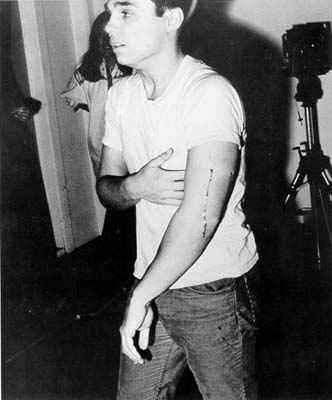
Chris Burden, Shoot,November 19, 1971,
F Space, Santa Ana, CA
"We have now become aware of the possibility of arranging the
entire human environment as a work of art, as a teacing machine
designed to maximize perceptoin and to make
everyday learning a process of discovery."
Marshall McLuhan, The Medium is the Massage, 1967
Pondering Chris Burden's performance piece, Shoot,mounted at F-Space in Santa Ana on November 19, 1971, we see that Burden (who studied for his B.A. in visual arts, physics and architecture at Pomona College and received his MFA at the University of California, Irvinefrom 1969 to 1971) played off what a camera does (shoot) while making a statement about the gravity of the gunfire in Vietnam, which has resonated through the decades. Electronic media allowed the below seven second film and audio documentation of a private event witnessed by 12 people to become iconic. Until we entered this era only material objects could attain the status of Art. Shootmade Burden a "living myth". When a UCLA student tried to do a piece with a gun in a graduate seminar, in 2005, Burden retired his position. McLuhan presaged Burden's performance piece "arranging of the entire human environment as a work of art" by 4 years.
To be fully aware of the media environment that saturates contemporary existence remains as important today as it was when Professor Marshall McLuhan wrote his infamous The Medium is the Massage nearly 50 years ago. He may have been thinking television, newspapers, radio and LP records but his ideas remain applicable to iPads, smart phones and Twitter. Students seem to feel powerless over how social networking sites like Facebook have come to replace face-to-face gatherings around the kitchen table and smart phones have become an extension of the nervous system. McLuhan famously wrote: "there is absolutely no inevitability as long as there is a willingness to contemplate what is happening. All media work us over completely. They are so pervasive in their personal, political, economic, aesthetic, psychological, moral, ethical, and social consequences that they leave no part of us untouched, unaffected, unaltered." His collaborations with book designers such as Quentin Fiore, appearances in mainstream TV talk shows and films such as Woody Allen's Annie Hall and use of the Columbia Records LPs as an "outlet" demonstrates his willingness to use media rather than be used. This morning wondering what he would Tweet and what he would say about our 140 character attention spans, the expanding global village and the power of the constructed self via the Facebook News Feed.