Douglas Engelbart (1925-2013),
whose vision of collaboration using computer technology to help solve
the urgent and complex problems of all of humanity, died on July 2,
2013. His comrades believed that his ideas were never fully realized due
to his ideals and generosity of spirit. For example, he resisted
patenting the "mouse" he'd invented and it eventually fell into the
public domain. The robotic rigidity of institutions is also to blame --
most powerful technology companies in American relegated him to R&D.
Ted Nelson, professor and inventor of the first hypertext project, delivered Engelbart's eulogy
on December 9, 2013. In his tearful delivery, he said the "...real
ashes to be mourned are the ashes of Doug’s great dreams and vision,
that we dance around in the costume party of fonts that swept aside his
ideas of structure and collaboration...Perhaps his notion of
accelerating collaboration and cooperation was a pipe dream in this
dirty world of organizational politics, jockeying and backstabbing and
euphemizing evil." Engelbart articulated his ideas for collaboration
publicly in what is known as The Mother of all Demos
delivered on December 9, 1968, nearly half a century ago. Some of what
he described is still in the process of being realized in commercial
forms such as Skype, Google Docs, and more.
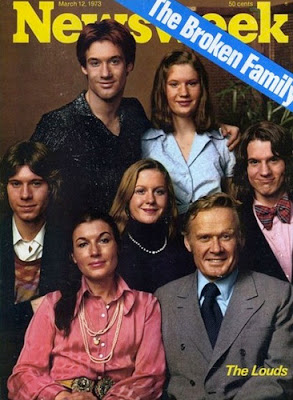
The Loud Family for the PBS documentary An American Family,
which "devastated" them when media called them "affluent zombies"
while accusing gay son Lance Loud (upper left) of
"camping and queening about like a pathetic court jester".
"We all become living specimens under the spectral light of ethnology,
or of anti-ethnology which is only the pure form of triumphal
ethnology, under the sign of dead differences, and of the resurrection
of differences."
-- Jean Baudrillard, Simulations (p. 16)
With the mission of chronicling the "daily life of the Louds - an
upper-middle class family from May 30 to December 31, 1971, PBS museumizedthe family as it fetishized their interactions and relationships in the series An American Family aired in 1973. They became specimens before the camera, which precipitated the parental divorce and the punk antics of Lance Loud, who had famously corresponded with artist Andy Warhol as a teen. Sited as the first "reality TV" show, An American Family changed the lives of the Louds, and it "changed my life," stated Craig Gilbert, the creator of the series stated in 2011 in a New Yorker interview. In a subsequent HBO drama titled Cinema Veriteabout the making of An American Family aired in 2011, the producers tried to "convey
the surreal enormity of An American Family to viewers who are more
accustomed to the idea of living in public, whether in front of cameras
or through social media" and understanding the innocence of the early
1970s. Writes Baudrillard, "More interesting is the phantasm of
filming the Louds as if TV weren't there. The producer's trump card was
to say: "They lived as if we weren't there." An "absurd paradoxical
formula--neither true, nor false: but utopian"(50) wrote Baudrillard
while concluding that the family were victims of a sacrificial spectacle offered to 20 million Americans (51-52). Such museumification
of human subjects continues more broadly today in everyday life
everywhere as every minute seemingly is captured and uploaded for all to
see. An American Life is a harbinger of the Internet exploitation of the individual and all of the social media disasters to come.
On October 1, 1908, the first production Model T
Ford is completed at the company’s Piquette Avenue plant in Detroit.
Between 1908 and 1927, Ford would build some 15 million Model T cars. It
was the longest production run of any automobile model in history until
the Volkswagen Beetle surpassed it in 1972.
Before the Model T, cars were a luxury item: At the beginning of
1908, there were fewer than 200,000 on the road. Though the Model T was
fairly expensive at first (the cheapest one initially cost $825, or
about $18,000 in today’s dollars), it was built for ordinary people to
drive every day. It had a 22-horsepower, four-cylinder engine and was
made of a new kind of heat-treated steel, pioneered by French race car
makers, that made it lighter (it weighed just 1,200 pounds) and stronger
than its predecessors had been. It could go as fast as 40 miles per
hour and could run on gasoline or hemp-based fuel. (When oil prices
dropped in the early 20th century, making gasoline more affordable, Ford
phased out the hemp option.) “No car under $2,000 offers more,” ads
crowed, “and no car over $2,000 offers more except the trimmings.”
Ford kept prices low by sticking to a single product. By building
just one model, for example, the company’s engineers could develop a
system of interchangeable parts that reduced waste, saved time and made
it easy for unskilled workers to assemble the cars. By 1914, the moving
assembly line made it possible to produce thousands of cars every week
and by 1924, workers at the River Rouge Ford plant in Dearborn, Michigan could cast more than 10,000 Model T cylinder blocks in a day.
But by the 1920s, many Americans wanted more than just a sturdy,
affordable car. They wanted style (for many years, the Model T famously
came in just one color: black), speed and luxury too. As tastes changed,
the era of the Model T came to an end and the last one rolled off the
assembly line on May 26, 1927.