Thursday, January 23, 2014

Sandy Dyas: my eyes are not shut

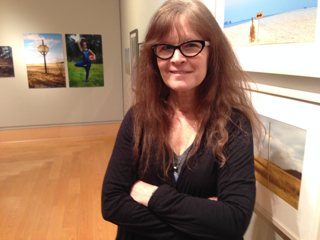
Sandy Dyas installing her exhibition, my eyes are not shut,
in the Wriston Art Center Galleries,
Lawrence University, Appleton, Wisconsin
January 15, 2013. iPhone photo by. J. Lindemann

"Be brave. Brave enough to listen to yourself," artist Sandy Dyas told a group of Digital Processes students at Lawrence University while on campus to install and open her "my eye are not shut" exhibition. The show at the Wriston Art Center Galleries runs January 17-March 16, 2014 and flows with around 100 prints installed with video. Color, form, light, and subject matter inter-relate associatively from one print to the next to communicate something of "the ever-changing, strange and beautiful world we live in." 
 
Dyas felt completely at home when she discovered the Intermedia MFA program at the University of Iowa in Iowa City in the 1990s. "My curiosity of the unknown drew me to Intermedia," she said. At the time the focus was on experimental video, performance, and the ephemeral. She describes her time there from 1992-1998 as utopian. There was a built-in community and she had access to video equipment. Dyas, Ana Mendieta, and Charles Ray are among the program's alum. "An outgrowth of Fluxus ideas of interdisciplinary creative activities, artist Hans Breder founded this first Intermedia MFA program in the US in 1968. It explored the "liminal spaces between the arts: art, music, film, dance, theater, and poetry" eventually embracing the liberal arts and currently social practice and all things digital.

"Experimentation was encouraged over everything," Dyas says. "We would endlessly discuss the merits and concepts of a work - although Hans was short on giving his opinions - I mean, he did, but he did not interfere with anyone’s creativity. I saw him as a figure who watched and listened intently but said very little — or at least did not elaborate. I believe what he did was create a safe and very open space for students to experiment with ideas." 
 
In the spirit of this experimentalism, Dyas used current online platforms to self-produce the exhibition and the accompanying book using Kickstarter and Blurb. She currently teaches photography and an Intermedia course at Cornell College embracing simple performance, performance on video, and the study of artists active in the 1960s and 1970s.

Sandy Dyas visits Digital Processes students on January 15, 2014. Photo by Sony

Saturday, January 18, 2014

Bell Labs Built the first Picturephone in 1956...

This ad likely corresponded with its appearance at the 1964 World's Fair. Of special note is the caption next to the screen image.

Saturday, January 11, 2014

Stan Brakhage: Expanding the Language of Film, Frame by Frame

One may read infinite interviews with independent filmmakers whining about making a $3,000,000 film on a $750,000 budget, but can we really pity them after we consider how Stan Brakhage (1933-2003) expanded the creative potential of the entire medium using nothing but blank film stock and some felt tip markers? The immensely influential filmmaker completed over 300 films while living a low budget life, working with amateur equipment and discards. His films take us to the extremes of our emotional states while dismissing the tedium of narrative structure. He has opened the doors to new understandings of human experience to all willing to accept his art.

Stan Brakhage - "Eye Myth" (1967)

Sunday, January 5, 2014

One of the Greatest Men of All Time


Douglas Engelbart (1925-2013), whose vision of collaboration using computer technology to help solve the urgent and complex problems of all of humanity, died on July 2, 2013. His comrades believed that his ideas were never fully realized due to his ideas and generosity of spirit. For example, he resisted patenting the "mouse" he'd invented and it eventually fell into the public domain. The robotic rigidity of institutions is also to blame -- most powerful technology companies in American relegated him to R&D. Ted Nelson, professor and inventor of the first hypertext project, delivered Engelbart's eulogy on December 9, 2013. In his tearful delivery, he said the "...real ashes to be mourned are the ashes of Doug’s great dreams and vision, that we dance around in the costume party of fonts that swept aside his ideas of structure and collaboration...Perhaps his notion of accelerating collaboration and cooperation was a pipe dream in this dirty world of organizational politics, jockeying and backstabbing and euphemizing evil." Engelbart articulated his ideas for collaboration publicly in what is known as The Mother of all Demos delivered on December 9, 1968, nearly half a century ago. Some of what he described is still in the process of being realized in commercial forms such as Skype, Google Docs, and more.

Tuesday, May 28, 2013

Paul McCarthy: The Last Artist We Needed to Meet

Artist Paul McCarthy with J. Shimon after McCarthy's lecture at
The Art Institute of Chicago, May 2012. Photographed by J. Lindemann

A person definitely gets over meeting famous artists after being hired to photograph them by the dozens. There was one remaining exception, a single artist who seemed to rise above, Paul McCarthy. Our friend John McKinnon organized a talk at the Art Institute of Chicago last May (2012), and somehow intuitively knew we needed to connect. It was a rather conventional artist's talk, focused on more obscure works and maybe with a thicker than normal air of discomfort with the action of speaking about oneself. A handful of people came on stage to get various things signed, rather quickly leaving Paul standing alone. I approached him, we started out laughing, had a short, abstract conversation about holes/passages, barriers/containment, voids/hollowness, and began weeping. Julie immediately intervened and asked him why he quit teaching. "Didn't want to become one of those" was his reply. Yea, that is an issue isn't it. A contemporary art member/MBA/golfer type then whisked Mr. McCarthy away to the special VIP fundraiser dinner. Such is the life of a visionary artist.


Paul McCarthy lecture opening slide
at The Art Institute of Chicago, May 2012.
The New York Times Magazine ran a feature on McCarthy's work on May 10, 2013 titled:

Sunday, May 12, 2013

More Real than the Real Thing: Media Artist Jack Goldstein on UbuWeb


Portrait of Jack Goldstein by James Welling
UbuWeb's founder, an American poet and professor of poetics at Penn State named Kenneth Goldsmith, writes: "It’s amazing to me that UbuWeb, after fifteen years, is still going. Run with no money and put together pretty much without permission, Ubu has succeeded by breaking all the rules, by going about things the wrong way. UbuWeb can be construed as the Robin Hood of the avant-garde, but instead of taking from one and giving to the other, we feel that in the end, we’re giving to all." It is on UbuWeb that a viewer can find a wealth of artist Jack Goldstein's works.

UbuWeb recently posted 10 films from the 1970s by Jack Goldstein (1945-2003), a Candadian born, California-based performance and conceptual artist. States UbuWeb, "Beyond their political content...the sheer beauty of Goldstein's '70s films constantly forces one to remember that, even when he deploys the strategies of spectacle ironically, Goldstein is a talented visual artist. That these works still look so fresh testifies not only to his refined aesthetic sensibility, but also to his influence on many of today's artists, for whom media culture and the loop have respectively become the subject and device du jour." According to the Jack Goldstein Estate website, "Goldstein was one of the first graduates of CalArts and went on to experiment with performance, film, recording and painting. This exciting early work of the late seventies, eighties and early nineties influenced many artists who came after him." His work was recently included in "The Pictures Generation" curated by The Met in New York City. Wrote Robert C. Morgan about Goldstein's work in the Brooklyn Rail: " There is a sense of ambiguity about it—an ambiguity without the weight of disaster. Instead, one senses a kind of arbitrariness in Goldstein’s work that is fully conscious of its beauty and elegance. His presentation is about the distance between beauty and the dark side of human and natural events, how they come together through a kind of poetic sublimation."

A suite of nine records (sound effects) by Jack Goldstein, 1979

Thursday, May 2, 2013

Transformation and Fair Use

Richard Prince from Canal Zone
French photographer Patrick Cariou sued Richard Prince for using/appropriating his photographs from his series Yes, Rasta circa 2000 as the basis of Prince's Canal Zone series circa 2012. The courts recently found that Prince had "transformed" Caribou's work to make a new more contemporary statement hence declaring it "Fair  Use".

Patrick Cariou Yes, Rasta (left) vs. Richard Prince Canal Zone (right)